

Findings and Conclusion about Women Empowerment in Pakistan

CHAPTER 5
FINDINGS, CONCLUSIONS AND RECOMMENDATIONS
The previous chapter presented the analysis of data. On the basis of data analysis the findings, conclusions, and recommendations are presented in this chapter.
Findings
Based on the analysis of data, following findings were drawn:
The sample consisted of 57% female and 43% male. The greater part of the sample was 30-45 years of age and rest of those were above 45. Majority of the respondents was married and the ratio between the married and unmarried was 78% and 22%. Most of the respondents were employees of public and private sector organizations and the rest were house hold. Their proportion being 17% house hold, 30% self-employed, 31% working in private sector and 22% in government sector. The educational level of respondents was 11% primary pass, 6% below matric, 12% matriculates, 34% graduates, 47% post graduates.
In the survey, 8% of the sample told that the women of 1988-2000 felt easy in the society, while 29% said that they did not feel easy and 63% of the sample said that they had no idea about it.
23% of the respondents said that the society respected the women, 32% were of the view that they did not feel respect in the society while 45% of the respondents said that they had no idea about it.
26% of the sample told that they felt safe in the society, 30% said that they did not feel safe in the society and 44% of the sample said that they had no idea.
79% of the respondents said that they knew about the violence against women, 12% said that they did not know about it while 9% of the sample said that they had no idea.
17.55% married women of the sample said that they faced domestic violence, 47.02% of the sample said that they never faced domestic violence while 35.42% married women said that they had no idea about it.
In the survey, 49% of the subjects told that they knew about the rights and obligations given by the religion while 51% of the sample said that they had no idea about it.
52% of the subjects said that they were in favour of working of women outside home. 41% of the subjects said that they were against women’s working outside home while 7% of the sample said that they had no idea.
16% of the subjects thought that purdah (veil) was a hindrance in development of women, 7% said that they had no idea according to 77% purdah was not hindrance in the development of women.
55% of the subjects said that participation of women in national assembly was not satisfactory during the era 1988-2000, 28% said that they were satisfied with the level of women participation during that period, while 17% remained undecided.
According to 21% of the respondents the ratio of representation of women in the national assembly was satisfactory during the era under study, 18% were undecided while 61% said that they were not satisfied with this ratio.
54% of the subjects said that representation of women in provincial assemblies was un- satisfactory, 29% were un-decided while 16% of the sample showed their satisfaction on this ratio.
In the total sample 15% said that the women were participating in the decision making process, 53% said that women were not participating in the decision making process during the era under study, while 31% was undecided.
51% of the subjects said that they did not think that women were fulfilling the primary responsibilities of politics, 26% said that they were fulfilling these responsibilities, while 25% were undecided.
53% of the sample said that they were not playing active role in the politics and their role was just dummy, 30% said that they thought the women were playing active role, while 17% said that they had no idea.
In the total sample, 80% said that women were not given full rights of land inheritance and were not authorized to use it according to their own will, 12% said that they had no idea while 8% said that the women had full the rights.
55% of the subjects said that women were fully provided by the facilities of food and basic necessities of life, 24% were undecided and 21% said that women’s right of food was not fulfilled during the said era.
89% of the respondents said that women were not authorized to exercise their power in the field of agriculture and they were working as a labourer, and 11% were undecided.
71% of the total respondents said that the wages in the industries for women were not satisfactory, 12% said that they were satisfactory, while 17% said that they had no idea about it.
75% of the subjects said that women did not have equal opportunities in the job field, 12% said that they had equal opportunities, while 13% said that they had no idea about.
In the survey, 81% of the respondents said that women had no authority in the labour force, 3% said that the women were authorized, while 16% said that they had no idea about it
60% of the subjects said that working environment for women was not satisfactory and encouraging during the said era, 13% said that it was satisfactory, while 27% were undecided.
81% of the respondents said that women had no authority in the labour union in that era, 19% remained undecided.
63% of the subjects said that women played equal role for the reduction of the poverty in the said era, 20% said that it was not so, while 17% were undecided.
36% of the subjects said that the government initiatives for the empowerment of women in that era were satisfactory, 39% did not consider these satisfactory, while 25% were undecided.
33% of the subjects said that initiatives for women empowerment by the NGOs were satisfactory, 46% of the subjects did not consider the same satisfactory, while 21% said that they had no idea.
In the survey 61% of the respondents said that women were provided with equal opportunities in education, 34% opined against it, while 5% said that they had no idea about it.
74% of the subjects said that the literacy rate had increasing trend in the era under study, 12% showed disagreement, while 14% were undecided.
In the said sample 53% of the total persons said that enrolment of women in education sector in that era was unsatisfactory, 28% said it was satisfactory, while 16% were undecided.
In the survey, 47% of the subjects said that education facilities for women at school level were un-satisfactory during that era, 7% remained undecided, while 46% showed satisfaction on the facilities for women at school level.
From the sample 55% respondents said that facilities for women at the college and university level were not satisfactory during that era, 35% said that they were satisfied with the facilities, while 10% said they don’t know about it.
78% of the subjects said that during the era under study women were not provided with adequate educational facilities, 7% showed their satisfaction at education facilities, while 15% said that they don’t know about it.
47% of the subjects had the opinion that women were provided proper health facilities during the era under study, 37% thought that women were not given proper health facilities, while 16% were undecided.
The analysis of the data shows that 51% of the respondents said that women were able to avail of basic health facilities, 40% said that they were not able to do so, while 9% were undecided.
71% of the respondents thought that women were not authorized to take part in decision making of the house hold issues, 21% said that they were able to do so, while 8% had no idea about it.
About the said era 73% of the subjects said that women were not authorized to take decisions regarding their own marriage, 26% were of the opinion that women were authorized to do so, while 1% were undecided about it.
46% of the respondents were of the opinion that women were provided with proper authority and status in family matters during the era under study, 42% said that women were not authorized at this level, while 12% were un-decided about it.
In the survey, 50% of the respondents said that women had no proper rights, authority and freedom of mobility in the society, 9% were undecided while 41% thought that women were having authority and freedom of mobility.
In the total sample 48% of the respondents said that during 1988-2000the public sector was working properly for the empowerment of women, 40% showed their opinion in negative, while 12% had no idea
80% of the subjects had the opinion that the parliament in the specified era was not making laws for the protection of rights of women, 10% said that the parliament was doing her duty properly while 10% had no idea
67% of the respondents had the opinion that NGOs were not working properly for the rights of women during the period under study, 11% had opined that NGOs were doing their work for the rights of women while 22% had no idea about it.
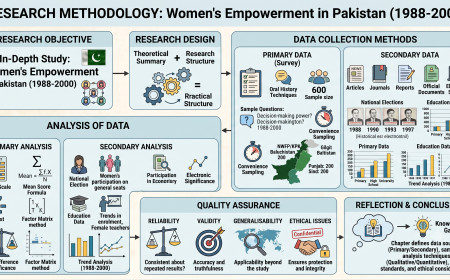
In the survey the significance of the opinion of male and female was also calculated and Z test was applied, the calculated value of “Z” was -3.11
The value of Inter-correlation among scale factors were all positive ranging from 0.52 to 0.64. Thus all the factors covered in the scale were correlated with one and other and showed internal consistency and provided validity of the instrument.
The coefficient of correlation among all factors had high positive value; therefore all the factors in the scale were associated with each other. It also showed internal consistency and validity of the scale.
Participation of women in national elections held during 1988-2000 was low and had negative trend with the time. During this era four elections were held, in 1988, 1990, 1993 and 1997. The highest ratio of women participation was in the election of 1988 and that was 1.42% on general seats while lowest participation was in the election 1990, which was 0.93%. In 1993 the ratio was 1% and in 1997 ratio was 1.24%.
Reserved seats figures also showed negative trend in women empowerment. In 1988 there were 20 seats of women but during the later three elections these were abolished and there was no reserve seat in the elections for women till the elections of 2002.
In the elections of 1988, the participation of women on general seats was more in the NWFP (now KPK) province in comparison to other provinces. The participation of women in Sind was 1.50%, in NWFP was 1.50%, in Punjab was 1.49% and in Balochistan and Islamabad it was zero.
In the elections of 1990, participation of women on general seats was more in Sind province and it was 1.20%. In NWFP (KPK) it was 0.98%, in Punjab 0.92%, and in Baluchistan and Islamabad it was zero.
In the elections of 1993, women participation in Sind and Baluchistan was equal and it was 1.07%. While in Punjab it was 1% and in NWFP it was zero percent. In these elections there was only one women candidate in Islamabad but there the ratio of women was 9.09%.
In the elections of 1997, women participation on general seats was higher in Sindh Province than that of other provinces. In Sind the ratio was 2.06%, in Punjab the ratio was 1.28% in NWFP it was 0.66% while in Balochistan and Islamabad it was zero.
In the elections 1988, eight women won on the general seats, in 1990 elections two females won on general seats, in 1993, 4 female candidates won on general seats and in the elections of 1997, seven female candidates won on general seats. But when we see the winning candidates in these elections majority of the female contestant belonged to big families and have the political legacy.
In the period 1988-2000, there was large difference in the male and female educational institutions. In 1988 male primary schools were three times those for females. The female schools were 26.42% of the total and after one decade in 2000 the ratio of the female schools rose to 36.12%.
In 1990, the ratio of female middle schools was 37.17% and in one decade it rose to 44.02%. There was improvement and increased ratio was 6.85%.
In the high schools the ratio of female institution in 1990 was 27.27% and in one decade it increased to 36.50%. Here the raise ratio was 9.23 percent.
In the field of higher education the gender disparity was there. In 1990 the female arts and science colleges were 36.27% and in one decade the figure rose to 40.26% and the increased ratio was 3.99%.
In professional education, the gender disparity was more than that in other fields. In 1990, the ratio of female professional colleges was 8.08% of the total. After one decade this ratio decreased and in 2000 it became 3.46%.
In universities there was also big gender gap. In 1988 there was no women university in the country and the total public sector universities of the country were 21. After one decade there was a little improvement and the total universities were 26 in which only one university was established for females.
In 1990 the female enrolment in primary schools was 36.79% of the total and after one decade it remained at 36.78% level.
In 1990, female enrolment in the middle schools was 29.84% while the male enrolment was 70.15%. After one decade in 2000 the female enrolment rose to 39.27% and the increase ratio was 9.43 percent.
Enrolment of females in high schools also shows the gender gap. In 1990 the female enrolment in high schools was 28.38% of the total enrolment. After one decade, in 2000 the female enrolment rose to 37.83% and the gender disparity was reduced with the ratio of 9.45% in the specified period.
In the arts and science colleges the enrolment of female in 1990 was 33.49% of the total enrolments and it was raised in the year 2000 to 46.96%. The improvement was 13.47% and helped to reduce the gender disparity.
In the professional colleges there was also gender gap, female to male ratio of enrolment was almost three times and that remained throughout the period under study. In 1990 the enrolment of female in professional colleges was 24.94% and in 2000 it was 25.49%.
In the year 1990 the female enrolment in the universities was 18.86% of the total. In 2000 the female enrolment rose to 24% and male enrolment was 76%.
In 1990, in the primary schools there were 33.36% female teachers while the ratio of the male teachers was 66.64%. In 2000 the ratio of female teachers rose to 34.71% of the total.
In 1990 the female teachers in middle schools were 38.04% of the total and in 2000 it rose to 48.41% of the total.
In high schools, the female enrolment in 1990 was28.78% of the total and in 2000 it increased to 33.52%.
In colleges the female teachers were 34.99% of the total in the 1990. In 2000 it was increased by 3.5% and total female teachers became 38.14%. While in professional colleges the female teachers in 1990 were 19.96% and in 2000 the figure dropped to 19.51%.
In the universities, gap between the male and female teachers remained throughout the decade under study. In 1990 the female teachers in the universities were 13.40% of the total teachers and in the year 2000 the ratio of the female teachers rose to 19.78%.
Conclusions
Pakistani society is complicated and male dominated where the women are facing a lot of problems, stiff socio cultural traditions and orthodox norms. Due to lack of social will, adherence to status quo and political inertia the situation is sustained and women are considered an entity of household. It is a mindset prevailing in the society that the duty of female members is only to look after home and the members of the family. They have little social, political and economic say in the society. Women empowerment is an effort for equalising female position in the society with men. Although women empowerment is fluid and flexible in nature but it allows changes on the basis of realities, level of consciousness, actions and perceptions. Concept of empowerment is holistic and its improvement in one direction does not mean overall empowerment. But this process led the women to improve level of consciousness and changes the mindset of male domination. In the present study this situation has been reflected in different fields of life. In-equality in Pakistani society among men and women also varies from to time, area to area and subject to the existing perceptions. Purdah (veil) is a strong social norm of Pakistani society but it has different shape in different locality of Pakistan and the perception about it varies from area to area.
There is a concept prevailing in educated society that Purdah (veil) is a hindrance in the development of women. But it is observed in the study that the majority of the respondents had the opinion that Purdah is no problem for working women and it is not a handicap for the women development. Role of Purdah always remained a big discussion in Pakistani Society because it is common and deep rooted in the society. In the cities and educated areas the shape of veil is not so stiff that it may be considered a hindrance in the development of women. It is assessed that due to this reason the people of cities were not considering the veil as a barrier for women in development process. But in orthodox culture the shape of veil is very tight and covered and it seems as a barrier in easy mobility of women. It is analyzed in the study that majority of the people think that women can move, work and play active role in the society in spite of observing purdah. In rest of the world veiling is a big issue under discussion and the governments are under pressure from the society to take clear cut decision on it. But in Pakistan majority of the people are in favor of purdah and they do not consider it an obstacle in the development of women.
As majority of the respondents were more than thirty years of age, so they were eyewitnesses of the era of study i.e. 1988-2000. Moreover, most of the respondents were married which shows the respondents had experience of domestic life as well. Respondents replied the questions with their memory and perceptions developed in their mind about the era of study. Their personal experiences and spending time of the said era is reflected in the responses.
It is significant that most of the respondents knew some incidents of violence against women. Two important conclusions can be drawn from this viz. the respondents were socially alert during the era under study and incidents of violence against women were familiar. Many respondents stated that they faced domestic violence, and it indicates that the violence against women was common during the period of study. However, it is surprising that half of the respondents had no idea of religious obligations and rights of women.
Three important findings indicate gradual change of traditional concept of role of women as “queen of house”. These findings were: (a) majority of the respondents thought that the people in the said era favoured working of women outside their homes, (b) the responses from majority of respondents that people in the said era did not consider purdah (wearing veil) as hindrance toward the development of women, (c) the participation of women in politics was less than it should be, and (d) Majority of the sample had an opinion that in the specified era, the women were not participating properly in the decision making process. It may be concluded that Pakistani society has realized the significant role played by women in development of the nation. National progress is impossible without active role of women, and this awareness was mounting gradually.
It is a common perception in Pakistani society that women are not made for working outside the home and domestic work is their basic responsibility. People are rigid in their norms and working women are not encouraged and they have no proper space in the society. But in line with the findings of this study the conclusion is made that it is a misconception that people of the said era were against the working of women outside home. Majority of the respondents thought that in the period of study people had the opinion that working of women in the said era was good for the society. This is reflecting the emerging change in the society and women were getting socially better space.
Women’s participation in politics of Pakistan remained low all time. In Pakistan, politics is a difficult task to do as it is attached to power and money. Women are not independent in making their decisions. Politics is also difficult for them because they have little liberty in decision making and money expenditure even they have their own land and earning sources. In politics, women have opportunity to use authority with their own will and it is sometimes un-acceptable to the male members of their family. With the findings, it is assessed that the women who had the political legacy were participating in the practical politics and majority of women were not doing active politics. Even the women were not trying to change the political situation as entering in the political process. Women participation in parliament in the decade of study decreased and there was no political movement in the said era. A factor of Benazir Bhutto played an important role and it gave encouragement to women as it was an example of power and authority vested in the hands of women. So in this period women’s participation in politics was increased slightly.
Women in Pakistan rarely had ownership of land and even if they had some land they did not get the efficient control over it. The traditional constraints and the customary practices were making the situation worse. This situation created the phenomena of male domination and this provided un-announced control of male on agricultural land. Fear of violence and social structure of the society was also creating hindrances for women to demand their inherited right of land. The state was not protecting women in agricultural sector and even the law and court of justice was not fully supporting them. Due to these conditions, the dependence of women on the traditional system increased and it was already biased for them. This situation is clearly reflected in the study as the majority of the sample had the idea that women were deprived of their land rights and they were not given proper rights according to the law during the era of study. The basics of Pakistani society are the teaching of Islam in which men and women are granted equal rights in all aspects of life. These teachings are reflected in statutory laws but the implementation on these laws is weak and women were not getting their proper rights of holding lands and they even did not enjoy the decision making on their own. In the study majority of the respondents had the idea that women were even not authorized to exercise their power in the field of agriculture and they were working just as a labourer in the specified era. Agriculture is a big sector of Pakistan and a large number of respondents was directly or in directly associated with it. Women having no authority in this sector show that the women at large in the society were not enjoying the rights in the society. The women had no access to the extension services of agriculture. In spite of a big role of women in agriculture sector there was no independent agriculture extension services for women. Due to the limited mobility and security issues large of numbers of women were forced to unpaid work in villages and this reflected a big hurdle in the daily income. It was also observed that the work of women was used for household consumption and it was not sold in open market. This situation reduced the monetary value of that work. The earnings of women were in the control of men and even they had no authority of expenditure on their own earnings.
Food and nutrition is important for women’s health and it is related to the women earnings in daily life. In the study, it was observed that the majority of respondents were satisfied that women were fully provided with facilities of food and other necessities during the period of study. Women were dependent on men in this field and they were not in a position to implement their own will by themselves. The wages of women in the industrial sector were low and it was opinion of respondents that women did not have equal opportunities for entry into the work field. These findings reflect the fact that in the relation to jobs and wages the situation was not satisfactory for women during the specified era. The situation has also similar reflection in the field of labour force where a large number of subjects said that the women had no proper authority without biases in the labour force sector. Even the work of women in agriculture fields was also considered as part of household duties and it was not calculated in the collection of labour force data. On the other hand, it was observed that the labour force was not a source of happiness for women and some time it proved double burden on the shoulders of women and it was not reflected in the well being of females.
There was a correlation between workforce participation and empowerment of women as it reflects in the betterment of daily life. The working women earn and they have little control over their money and expenditure. Working women also enjoy better social status than house hold women. It was also observed that paid work itself was not sufficient condition for empowerment because in spite of earning, women did not have full control of their earned money. There was even no sole and clear relationship between female empowerment and economic independence of women. Several factors determine the status of women empowerment. In these factors mobility of women, access to resources, participation in decision making inside and outside home are important. But paid work played a big role for the female empowerment and it is assumed that women’s income increase their autonomy.
The working environment is also important for the mobility and employment of women. This environment encourages or discourages women to go outside their home for labour. In the study, the majority of the respondents were of the view that the environment was not satisfactory for women during the era of study and women had no position and authority in the labour unions. It reflects that the working conditions for women were not good during the era of 1988-2000 and these conditions were reflected in almost all fields of working environment. In the job opportunities, participation in labour unions and about the wages, women were suffering during the era under study. The laws of land and customary practices created hurdles for gender parity. It was observed that the issue of purdah also created a manifold situation in labour force of industrial sector as it was creating a mark of social differentiation in the society. Women were working in the low paid and unskilled jobs and these jobs were more tiring and time consuming. Women had no information about the opportunities and no proper access to them. These factors were reducing the women empowerment with the reduction of economic activities for them.
It was observed that the unemployment of women was higher in all age groups than men. Even, there was less priority to women in the hiring policy and due to poor economic conditions women were more vulnerable during the economic recession. Laws of land were silent on the equal value of work of both men and women and their rights as domestic worker.
Due to lack of women’s mobility, they suffered from insufficient information about the economic opportunities resulting low participation in formal sector. The cultural view that women have low status was also contributing as a hindrance in their economic activities. During the period of study there was no big change in the empowerment of working women and the traditional role of women remained almost same.
Poverty is another big factor of gender discrimination in Pakistani society. Fewer resources have more effects on women as they are considered vulnerable. In the study, the majority of subjects were of the view that women were playing equal role in the society for reduction of poverty but in spite of it they were not getting proper share in the resources. It means that the respondents were satisfied with the role of women but they were not satisfied with the role of society. It shows that the women were struggling to get proper space and share in the society for their rights and obligations during that era. It was assessed that working of women was there for their family and society but it was not reflecting on their own well being.
It is worth mentioning that half of the respondents were of the opinion that government initiatives for empowerment of women were satisfactory during that period while half of the subjects showed their dis-satisfaction with it. Almost one fourth of the sample remained un-decided. This result shows mixed opinions about the government initiatives and reflects a clear division in the society. But the picture also shows that the people were not satisfied properly with the role of government for women empowerment. With the calculation of un-decided and dis-satisfied respondents it was assessed that majority was not satisfied with the role of government for the empowerment of women.
There was also distrust regarding the working of Non Governmental Organization in the era of study. The majority of the respondents were also not satisfied with their working for the empowerment of women. However, in the comparison of government and nongovernment sector the NGOs were on the better pace according to the respondents.
In the decade of study the literacy rate of women was increasing gradually but the process was slow during the era 1988-2000. It was also apparent from the secondary data analysis and was reflected in the budgetary estimates and economic surveys. It was the opinion of respondents that enrolment of women in education sector during the specified era was not satisfactory. This was also validated by the data analysis gathered later. However while there were initiatives for increase of enrolment of women, in this department the steps taken were not enough and satisfactory. Budgetary allocations in this respect were also poor and were not result oriented.
Facilities provided for females by the government at school level during the said era were also not satisfactory. The majority of the respondents were not satisfied with the steps taken by the government in this decade for the better facilities for women at school level. The situation regarding colleges and universities was also the same and the majority was not satisfied with the facilities for women in these institutions during that period.
The situation of rural areas was poor as it was not the priority of the governments in the said decade. It was observed with the available data on this issue that the situation of educational facilities was worst in the rural areas as the large number of population was deprived from this basic right. The situation in interior Sindh, Baluchistan, KPK (NWFP) and in South Punjab was particularly at low level.
Health facilities in Pakistan always remained inadequate and large portion of the population had no access to basic health care. While it is a duty of government to provide health facility to the citizen, this is not fulfilled. In the study, the majority of respondents said that the women had no proper health facilities during the era 1988-2000. Women were not able to avail of basic health facilities during that period and the situation was worst when compared to later years. In the rural areas people were suffering more in the field of health and the majority of sufferers were women. The huge negative impact was on the women as they were more vulnerable in the society. Even, health sector was not a big priority of the government and the policies had the biasness in segregated data of urban and rural. The spending in rural areas in health sector was less than the actual need of the population where the women were in worst conditions.
In Pakistan women are considered ‘queen of home’, reflecting a belief that they enjoy full authority in the four wall of house. But in the period of study women were not getting proper share in the decision making process of their own daily life. The majority of respondents had the opinion that the women were not authorized in the decision making process of their own marriages. It means that women were not allowed independence in their own life’s plan but they had a share in the liabilities of household process.
It was opinion of the majority that the parliament was not making proper laws for the protection and rights of women during that decade and this was a big reason of women’s vulnerability. People were not satisfied with the role of NGOs for the protection of the rights of women during the said era.
Analyses of the data revealed that the majority were of the opinion that the level of women empowerment during the era under study was at a low level. With the help of person measurement it was concluded that majority of the respondents was of the opinion that women were not fully empowered in the discussed field and there was negative trend in the process during the decade.
From analyses of the opinions of male and female respondents separately and by comparing their opinions, it was concluded that both male and female subjects believed that women were not empowered during that era. Thus the sex difference had no significant effect on the opinion of the respondents.
The value of inter-correlation amongst scale factors were all in positive ranges. All the factors, political, social and economic, included in the scale were inter-correlated and showed internal uniformity and provided validity of the instrument.
The coefficient of correlation among all the factors studied had high positive value, i.e., these factors in the scale were associated with each other. It also showed the internal evenness and validity of the scale.
Participation of women in the national elections held during 1988-2000 was low and had a negative trend with the passage of time. In the four elections of 1988, 1990, 1993 and 1997, the highest women participation took place in the election of 1988 while lowest participation was in during that of 1990. The indicators showed that in 1988, Benazir Bhutto as a female leader and icon of struggle was leading the election movement, so it attracted women more towards the election process.
Reserved seats data also showed negative trend in women empowerment. In 1988 there were 20 seats for women but during the later three elections these were abolished and there was no reserved seats in those elections for women till the elections of 2002. So, in the constituent assembly there was low representation of women during the decade of 1990-2000.
In the elections of 1988, the participation of women on general seats was more in the NWFP (KPK) province as compared to other provinces. The participation of women in the other provinces was also low but in Baluchistan and Islamabad it was zero.
In the elections of 1990, the participation of women on general seats was more in the province Sindh then in NWFP (KPK) and then in Punjab and in Balochistan and Islamabad it was zero.
In the elections of 1993, women participation in Sindh and Balochistan was equal but very low. While in Punjab it was 1% and in NWFP it was zero percent. In these elections there was only one women candidate in Islamabad on general seats.
In the elections of 1997, women’s participation on general seats was higher in Sindh province than that of other provinces. In the Sindh the ratio was 2.06%, in Punjab it was 1.28% in NWFP it was 0.66% while in Balochistan and Islamabad it was zero.
Women won general seats in the national assembly as follows: in 1988, eight; in 1990 two; in 1993, four; and in 1997 elections seven female candidates won. However, a large majority of winning female candidates had political legacy of their families.
In the period 1988-2000, there was a large difference in educational institutions for males and females and there was gender disparity. In 1988 primary schools for males were three times the number of those for females. During the decade there was improvement but the gender gap persisted.
In 1990, the ratio of female middle schools was 37.17% and in one decade it was raised to 44.02%. There was improvement and raised ratio was 6.85%, but the gender gap remained during the decade.
The female secondary institutions in 1990 were also less, we see improvement in this field with a rise of 9.23% but the ratio was still for away from the gender equality. In the field of higher education the gender disparity was also there. In 1990-2000 there was increase in the female institutions by 3.99 percent but the gender gap persisted.
In professional education the gender disparity was greater than that in other fields. In 1990, the ratio of female professional colleges was 8.08% of the total. During the decade under study this ratio decreased and in 2000 it became 3.46%. There was gender gap but the government was encouraging co-education and the new established professional colleges were for both sexes. Thus the need for separate female professional colleges was not felt.
In universities there was also gender gap. In 1988 there was no women university in the country and the total number of public sector universities in the country was 21. During the decade under study there was minor improvement and the number of universities was raised to 26 in which only one university was established for females. There seems to be a large gender gap, but all the universities were co-educational. Thus female students had equal opportunity of university education during that era.
Enrolment of female students in educational institutions is also an indicator of women empowerment. With the help of data analysis, it was concluded that in the specified era, there was gender disparity in enrolments at school education. In 1990 the female enrolment in primary schools was 36.79% of the total and after the decade it was slightly lower at 36.78%. So there was no big change in the female enrolment during the decade and the gender disparity in this field continued.
In the middle school enrolment there was also gender gap during the period under study. During the decade increased ratio in this field was 9.43%. The increase in enrolment of females in middle schools was visible and the gender disparity was reduced but the gender disparity persisted.
Enrolment of females in high schools also showed gender gap. In 1990 the female enrolment in high schools was 28.38% of the total. After the decade, in 2000 the gender disparity in this field was reduced by ratio of 9.45% in the specified period.
In the arts and science colleges the enrolment of females during the decade under study showed a visible change and the female enrolment equaled that for male students.
In the professional colleges the situation was quite different and the gender gap was almost three times and that remained in all specified areas of study. In 1990 the enrolment of female in professional colleges was 24.94% and in 2000 it was 25.49%. So there was nominal improvement in this field during the era under study and gender disparity continued.
Female enrolment in the universities also showed gender discrimination. In the year 1990 female enrolment in the universities was 18.86% of the total. In 2000 the female enrolment rose to 24% and male enrolment was 76%. So a big gap in the enrolment in universities between male and female remained during this era.
Bifurcation of male and female teachers in the education sector also shows the economic and social empowerment of women. From the data analysis it was concluded that there was gender gap in the hiring of teachers in 1988, it remained so up to 2000 with little improvement. In the year 2000 the ratio of female teachers was raised to 34.71% of the total. During the decade nominal improvement in female ratio was observed but the gender discrimination continued.
In 1990 the female teachers in middle schools were 38.04% of the total and in 2000 the ratio rose to 48.41% of the total. It was concluded that gender gap was improved to almost at par with that for the males by the end of the decade.
In high schools, the female recruitment in 1990 was28.78% and in 2000 it increased to 33.52 percent. Thus, there was a visible change, but the gender gap continued at the beginning of new millennium.
In arts and science colleges and in professional colleges the numbers of female teachers were also less than that of the male. This situation continued during the decade with little improvement rather with some decrease.
In colleges the female teachers were 34.99% of the total in 1990. In 2000 it increased by 3.5%. While in professional colleges it showed little reduction in the female percentage that means in this field women’s empowerment was reduced.
In the universities there was gap between the male and female teachers, it remained throughout the decade. During the decade under study, there was little improvement in the female teacher’s ratio in the universities thus gender discrimination was there and it remained throughout the era.
With this analysis we reached the conclusion that the gender discrimination during this era was a dominating factor in the society. Although efforts seemed to have been made in all the area of life to reduce the gender gap but the public and private sector did not succeed to bridge it. However the women seemed to work and struggle for reducing the gender discrimination in all fields.
In the beginning some important research questions were raised and after the data analysis we reached on the conclusion to give the answers of these questions.
· The level of social, political and economic empowerment of women in the era of 1988-2000 was very low and women were in suppression of structured norms.
· The social, political and economic factors of women’s empowerment were inter correlated and the deprivation of women and gender gap was found all these departments.
· The distribution of resources was not equal for males and females and the gender gap was present, especially in the field of education and health.
· The women’s participation in political process was low and in the four elections of the said era, participation of women in elections on general seats was nominal and reflected the true sense of participation of women in political process.
Recommendations
From the findings and conclusions of the study, large gender gap in all fields of life in Pakistan was revealed. It was found that women were trying to get the available space to improve their life and working conditions. In education sector, in spite of disparities in the distribution of resources the women enrolment and literacy rate was increasing. The potential and urge to improve among the women were apparent. It is important to reduce the gender gap in health and education sector to get better results that may be used for benefit of the society.
There was imbalance among the role of men and women their rights and obligations. A strong system of civil society is required to educate the people for creating balance in the role of men and women. Positive changes in the customary practices, budgetary allocation and statutory law are needed for this purpose. It is essential for the state to become gender neutral which is lacking at the government side. Attitude of Pakistan politics need a change towards women empowerment which is badly damaged due to the inconsistent system of government.
The political parties of Pakistan may review the situation and should enhance participation of women in the political process so that their share in decision making may increase. The female participation in elections on general seats should be enhanced by taking encouraging steps in ticket distribution by the political parties.
On the basis of the research and its findings, the following recommendations were made for future researches:
· Future researcher may evaluate the impact of the development in women empowerment during the following decade.
· Sample of the future studies may be extended to the provinces and the data of the elections of provincial assemblies may also be analyzed.
· A detailed study may be undertaken in the field of female health issues.
What's Your Reaction?
 Like
0
 Dislike
0
 Love
0
 Funny
0
 Wow
0
 Sad
0
 Angry
0

Comments (0)